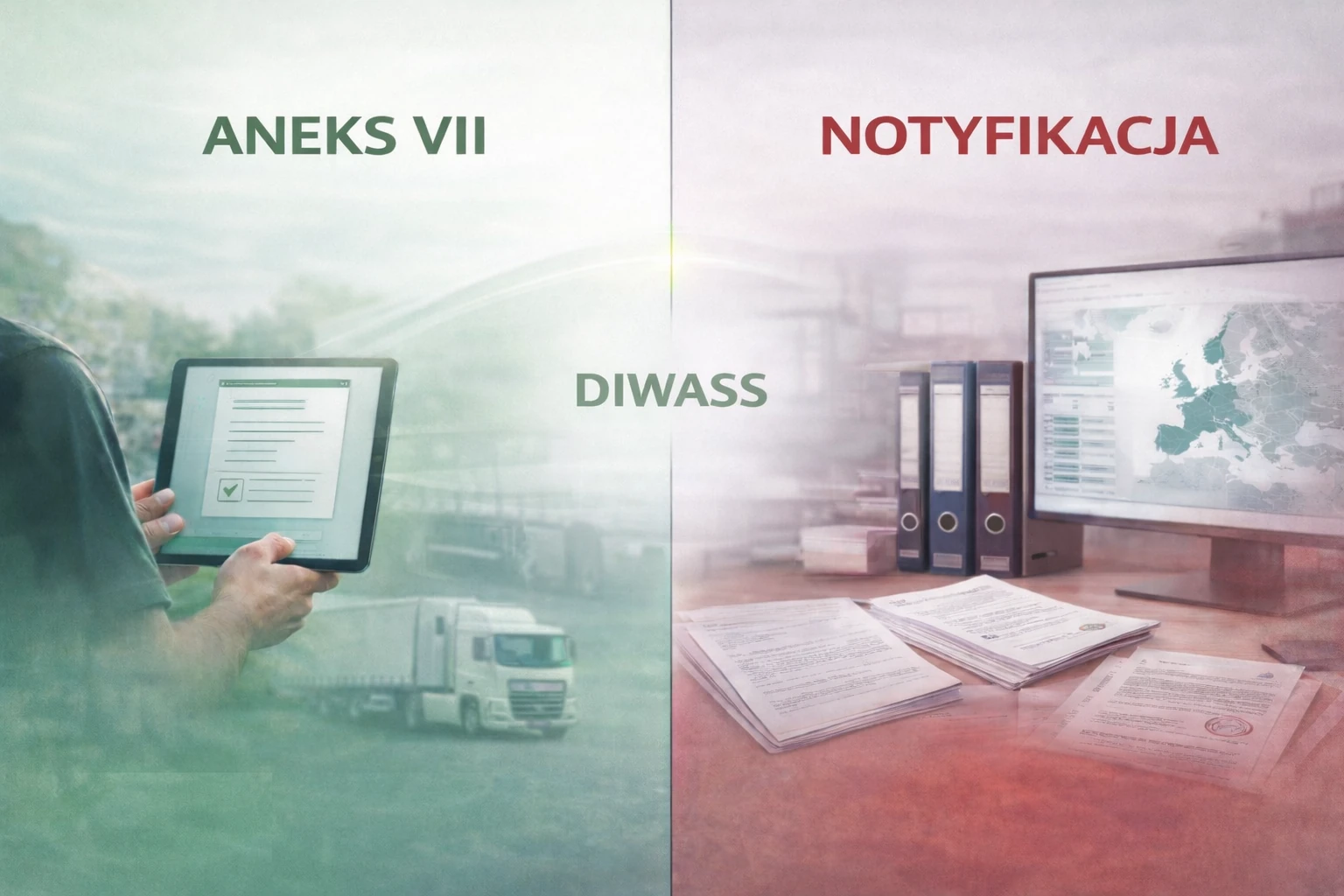
What operations does DIWASS support? System functions in practice
What operations does DIWASS handle and how will this system change waste transport in Europe? It will introduce a model of conduct in which the participants in the transport verify with whom they are carrying out the operation, and the transport itself will be based on shared, consistent information. The platform will thus increase transparency in the waste supply chain. It will have a history of changes to data and documents, so it will make it more difficult for practices such as the neutralisation of documents, their substitution after the fact or „adjustments” after the transport has been completed.
Contact us
DIWASS is not just a register, it is first and foremost an operating system. See how to prepare your company to work with it in your daily transports.
Justyna Blazewicz-Seredyn
Ewelina Nadolna
DIWASS as a space for control and shared responsibility
DIWASS will not operate like a classic register, where data goes only for record-keeping purposes. It is intended to create a common operating space where information on the entire waste transport process is collected. Importantly, this information will be accessible to the various parties involved in the transport. This will enable each of them to check the accuracy of the data on an ongoing basis and not only at the time of inspection. Instead of relying solely on paper documents, participants in the operation will gain the ability to check the information directly in the system.
This approach changes the logic of responsibility. This is because the control will not end with one entity, but will be spread over the entire transport chain. At the same time, DIWASS is expected to reduce the risk of fraud, as several participants will see the same data and can react to possible irregularities.
Access to DIWASS and identification of actors in the system
Although the waste holder is in principle responsible for the correct preparation of documents and the accuracy of waste transport data, DIWASS will change the practice of verifying these. Both the carrier and the consignee have to confirm this data to avoid problems in the further course of the transport or during inspections. This operating model follows directly from the idea of shared responsibility. If one participant relies solely on the assumption that „someone else is sure to do it correctly”, the risk of error is transferred to all. DIWASS aims to prevent this by enabling every authorised actor to check key information in one place.
Access to the electronic waste transport management system is to be via EU Login. It will be the primary mechanism for user authentication. This ensures that every action performed in DIWASS is unambiguously assigned to a specific user and entity. This solution strengthens the reliability of the data and eliminates situations where it cannot be established who is responsible for entering or changing information.
What operations does DIWASS support?
One of the key areas of DIWASS is the handling of both transport operations and the accompanying documentation. The system is designed to organise waste haulage information in a single digital environment, rather than dispersing it between paper documents, emails and various records. However, the platform is not limited to the shipment itself. It also encompasses the documents and formal activities that precede the transport, accompany it during, and close it down afterwards. In this way, the system bundles the entire process into a single, coherent data structure.
Documents under the prior written notification and consent (notification) procedure
Of particular importance in DIWASS is the handling of documents related to the prior written notification and consent procedure, commonly referred to as notification. The system covers documentation from the moment the notification is made until the completion of the shipments to which the competent authorities have given their consent.
Through DIWASS, in particular, the following will be transmitted and handled:
- notification document, together with all additional information and documents required in accordance with Annex II to Regulation (EU) 2024/1157;
- all correspondence between the notifier and the competent authorities in the context of proceedings for the authorisation of a notified shipment;
- the decisions of the competent authorities relating to the notification in question and the planned shipment;
- transmission documents for individual shipments carried out under an approved notification.
The handling of these elements in a single system means that the documentation no longer functions in isolation from the transport itself. Each document is linked to a specific declaration, decision and actual transport, which significantly increases the transparency of the entire process. Importantly, as with other data in DIWASS, any interference with the documentation will leave a trace in the system. This makes it possible to reconstruct the full history of the proceedings.
Transports carried out under Annex VII
DIWASS will also handle waste shipments carried out under Annex VII, the General Information Procedure. It is used for shipments of certain types of waste that do not require notification. In practice, this means that also those shipments, which up to now were mainly based on paper Annex VII documentation, will be integrated into the digital information flow in the system. It is intended to enable the transmission, collection and verification of data on such shipments in a single system environment.
A key change, as in the cases of Annex IA and IB in the notification, will be the linking of Annex VII to a specific transport operation and to transport participants. The data contained in the document will cease to function solely as an attachment „to be presented” and will become part of a coherent process visible in the system. This will enable both the carrier and consignee to check the accuracy of the information in advance, instead of relying solely on the documents physically transferred with the cargo.
As with other data in DIWASS, any changes or additions to information on Annex VII transports will be recorded in the system. This will increase the transparency of the transports and reduce the risk of unauthorised corrections to the documentation after the transport has already been completed.
What DIWASS does not cover
We already know what kind of operations DIWASS handles and that it concerns the supervision of the transport of neutral and hazardous waste. Data, documentation and the course of the transport operation are involved. However, the system does not cover the entire ecosystem of environmental responsibilities.
What DIWASS IS NOT and what it does NOT replace:
- It does not replace national registers and administrative obligations. They still apply in parallel.
- It does not assume responsibility for the correct classification of waste.
- It does not relieve of the obligation to have the required permits, registrations and authorisations to operate.
- It does not replace administrative decisions and does not „legalise” the activities of companies that do not have them.
- It does not remove the obligation to comply with country-specific requirements.
- It does not abolish the responsibility of transport participants to comply with the law.
- It is not a universal tool that solves all organisational problems in waste transport.
In practice, DIWASS is worth considering as an oversight and transparency tool.