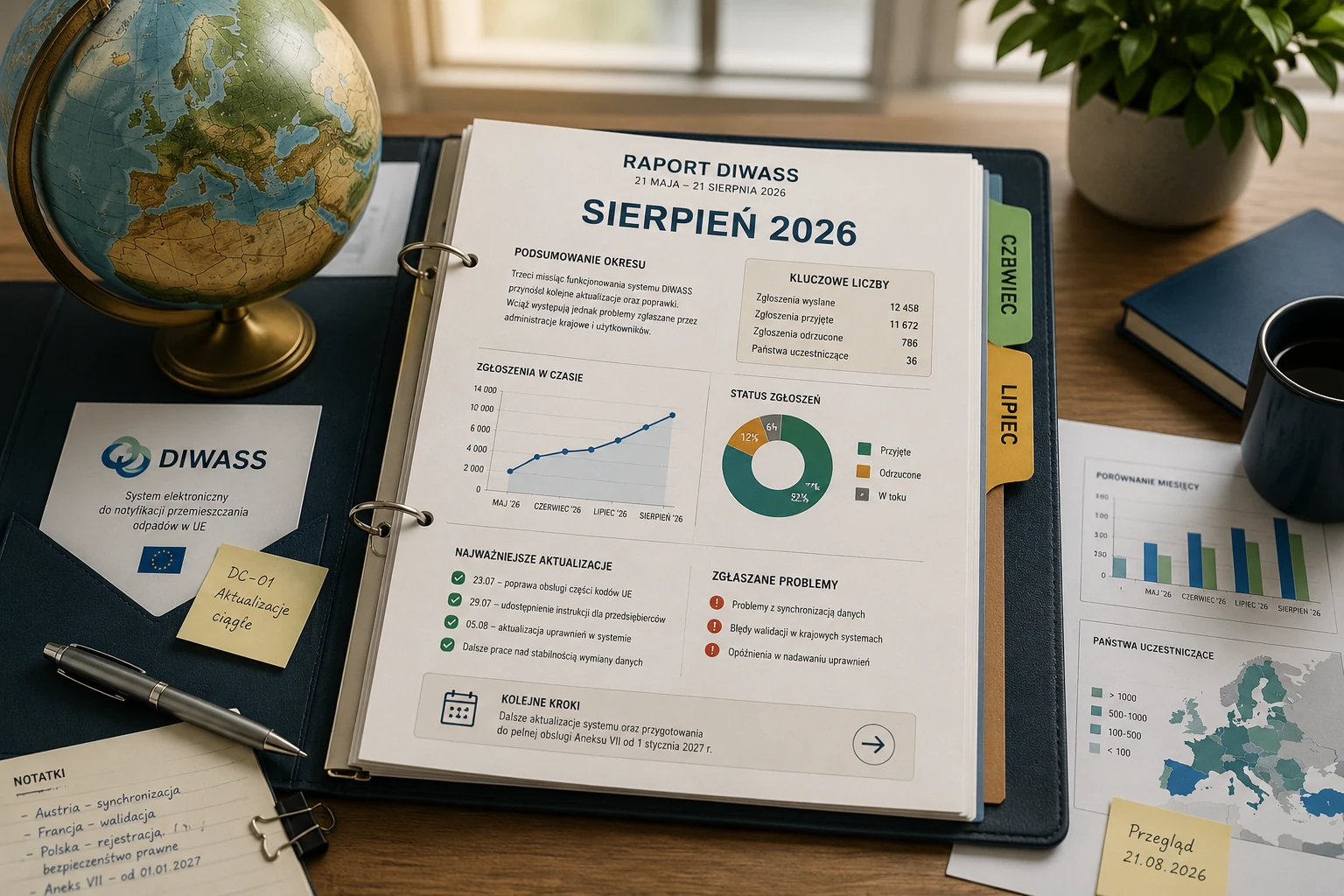
DIWASS system performance report: first three months – 21 May – 21 August 2026
The report on the performance of the DIWASS system after its first three months shows that the digitalisation of transfrontier shipments of waste has not gone entirely smoothly. The system was launched on 21 May 2026 and was intended to simplify procedures, speed up the exchange of information and reduce red tape. Meanwhile, the very first weeks brought errors, synchronisation issues and successive updates. This does not mean, however, that DIWASS is not working. The notification procedure is functioning and the system is being gradually improved. After three months, however, it is possible to compare the initial announcements with what the digital revolution looks like in practice.
Contact us
FAILURE TO REGISTER WITH DIWASS IS ILLEGAL WASTE MOVEMENT! DON'T TAKE THE RISK!
Justyna Blazewicz-Seredyn
Ewelina Nadolna
What was announced before the launch of DIWASS?
On 21 May 2026, a new phase in the digitalisation of cross-border shipments of waste was scheduled to begin.
The European Commission had announced, above all, faster processing of notifications, automatic data transfer and access to the current status of shipments. The authorities, in turn, were to receive information needed during inspections more quickly.
The benefits were also supposed to be financial.
According to Commission estimates digitisation was supposed to reduce administrative costs of entrepreneurs and authorities by about €1.4m a year. The Commission stated this value in an official press release published on the day DIWASS was launched.
The objectives were therefore ambitious: less paper, a faster flow of information and fewer delays.
After three months, we can already see how this looks in practice.
Is everything working as it should?
DIWASS is operational in its core areas.
From 21 May 2026, the system will handle the procedure for prior written notification and consent electronically. As explained by the Chief Inspectorate for Environmental Protection, DIWASS is used to submit, amongst other things, notification documents, additional information, correspondence with authorities, decisions and consignment documents relating to specific shipments.
At the same time, it is difficult to consider the system as fully stabilised.
This is best illustrated by the European Commission’s own statements, which indicate that the system is constantly being developed.
Changes may include, amongst other things, workflows, field descriptions and links between individual functions. The Commission therefore advises users to keep up to date with the latest information published through official channels. At the same time, on diwass.org We continuously gather the most important updates, announcements and changes regarding the system's operation.
The conclusion is simple: DIWASS works, but it is still evolving.
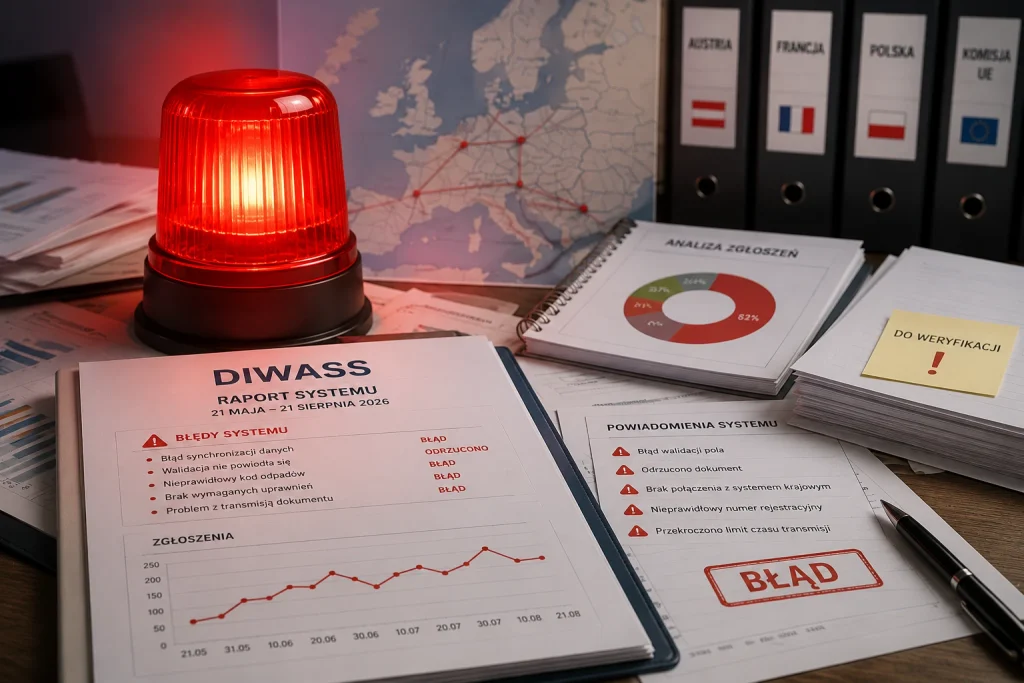
What issues and errors have been reported?
The problems experienced during the first few months were not limited to individual users.
Some of them were officially described by national administrations. Particularly concrete information was published by Austria and France.
Data transmission delays
On 29 July, the Austrian administration announced an error in the DIWASS central system.
The problem was causing transmission delays. As a result, it was not possible to receive up-to-date data from DIWASS correctly.
A day later the situation partly improved.
It was once again possible to download the notification data, but the system was still not operating reliably. The authorities also warned of long synchronisation times.
It was not therefore a problem with a single account. It concerned the communication between DIWASS and the national system.
It was not possible to download some of the attachments
On 30th July Austria reported another problem.
On this occasion, the problem was caused by a permissions error in the DIWASS system. As a result, users were unable to download attachments relating to import and transit notifications.
The issue also covered the appendices to requests for additional information, decisions, notices, and post-approval amendment applications.
In the notification procedure, this is no minor inconvenience. Access to such documents is one of the fundamental aspects of handling the case.
DIWASS did not accept valid codes
Some issues related to the data validation itself.
The Austrian side reported that, following the DIWASS update from 23 July 2026. The incorrect handling of some EU waste codes has been rectified.
The administration even gave a specific example: 16 06 03*.
Previously, the system did not accept it correctly. The update also restored the missing UN class 9.
The optional field was not always optional
The same update also fixed another bug.
The collection notification contained a field for additional information. It was supposed to be optional, but DIWASS did not always treat it that way.
Following the aforementioned update on 23 July, the system correctly began allowing the field to be left blank.
A minor error?
In a system that automatically validates forms, even a single field can effectively stop the entire process.
France: one missing contact person can block the documentation
An even more interesting picture of the first months of DIWASS's operation is provided by France.
French National Transfrontier Waste Shipment Centre (PNTTD) reported on 16 July about issues with the transfer of export documentation from the GISTRID system to DIWASS. The message was updated on 5 August.
On the page French GISTRID system The administration indicates very specific reasons for rejecting documents.
One of them sounds trivial: the lack of the carrier's contact person name.
PNTTD stresses that in the case of all carriers You need to provide your first name, surname, phone number and email address. The lack of a first name was one of the errors blocking the forwarding of the documentation to DIWASS.
64 characters and not a single one too many
The length of the entered information also caused problems.
The French administration has set a limit 64 characters for information concerning the place and process of manufacture and the place and process of processing.
For other fields, however, it recommends limiting the content to about ten words. An overly elaborate description may be rejected by DIWASS.
„N/A” may do more harm than good
There is also a less obvious pitfall.
If the given field does not require a code, the user should not type „-” or „N/A”. According to the PNTTD instructions, the field should simply be left blank.
However, the warning concerning the codes of the relevant authorities sounds the most serious.
The French administration states that entering the incorrect authority code may mean having to preparing all the documentation from scratch.
Digitisation was supposed to reduce bureaucracy. At the current stage, however, it requires a very high level of precision from users.
Poland: problems were already arising at the registration stage
In Poland, the Inspectorate for Environmental Protection (GIOŚ) has not hitherto reported a failure of the national DIWASS component similar to the problems reported in Austria. However, difficulties arose at the stage of entity registration.
On 18 June, GIOŚ published a special announcement in which it drew attention to incorrectly completed applications. The Inspectorate reminded that incorrect data leads to the rejection of the registration and lengthens the entire process.
However, it was not a technical system error. The problem primarily concerned the correct preparation of data and the completion of the entity approval procedure.
Issue of legal certainty
Not all the difficulties associated with DIWASS were of a technical nature. In the case of the postponement of the mandatory servicing of Annex VII of the Inspectorate for Environmental Protection (GIOŚ) he also drew attention to the legal issue.
The Inspectorate acknowledged that the transitional arrangement proposed by the European Commission is not ideal from the point of view of legal certainty for businesses. It also stated that it is examining the possibility of introducing a national provision to regulate this situation.
Annex VII – the biggest compromise before launching the system
One of the most significant changes took place even before DIWASS began.
The original model provided for the electronic sharing of information from Annex VII in accordance with Article 18 of Regulation 2024/1157.
However, the full implementation of this element has been postponed.
W appendices to the report of the Expert Group on Waste Movement of 27 March 2026. Issues were highlighted regarding the assurance of the proper and timely functioning of connections between the central DIWASS, national systems and the software used for the exchange of Annex VII documents.
As a result, the member states adopted a transitional solution.
As GIOŚ confirms in its communication regarding Annex VII, from 21 May to 31 December 2026. the document may be prepared and transmitted in paper form outside of DIWASS in Poland.
However, it is still necessary to use the new form template and have a contract in accordance with Article 18 of Regulation 2024/1157.
Importantly, the postponement did not fall under the notification procedure. The obligation to use DIWASS for new notifications entered into force on 21 May 2026.
Therefore, the first three months of the system's operation can be assessed primarily on the basis of the handling of notifications and the associated transmission documents.
What will change from 1 January 2027?
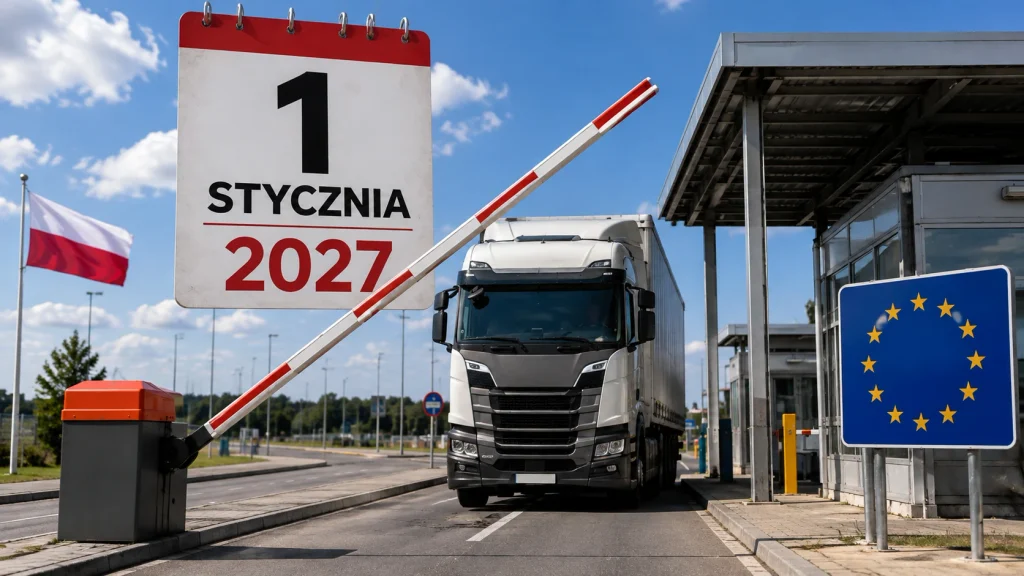
If the current schedule is maintained, 1 January 2027 will be another major test for the system.
As GIOŚ currently states on its website regarding shipments of green-list waste, after 31 December 2026 such shipments are to be carried out via DIWASS.
Above all, the way transport is prepared will change.
In accordance with Article 18 of Regulation (EU) 2024/1157, the person arranging the shipment shall complete the required information in Annex VII at the latest two working days before the start of transportation.
However, not all data needs to be known so far in advance.
The actual quantity of waste, the details of the carrier or carriers and, where applicable, the container identification number may be communicated at the latest before the transport starts.
The changes will also cover the post-delivery stage.
The recovery installation or laboratory will have to confirm receipt of the waste within two working days of receiving them by completing the relevant information in Annex VII. This stems directly from Article 18(8) of the regulation.
Therefore, 1 January 2027 may prove to be a greater operational challenge than the launch of DIWASS itself in May.
The scale will simply be completely different.
Three months of DIWASS. A revolution or still a work in progress?
After the first three months, it is difficult to give DIWASS a definitive assessment.
The system has moved the notification procedure to the electronic environment. At the same time, official communications from national administrations confirm issues with synchronisation, access to attachments, data validation and communication between DIWASS and national systems.
Some of the bugs have already been fixed. Further changes are being implemented.
Moreover, the European Commission itself admits that the IT environment remains in a state of constant development.
Has DIWASS already fulfilled all the announcements from 21 May?
Not yet.
However, this does not mean the project has failed. It seems more accurate to state that, after three months, the European digitalisation of cross-border waste shipments is still transitioning from the implementation phase to stable, everyday operation.
The real test may come at the beginning of the new year.
Only then will it become apparent whether DIWASS is ready not so much for complicated notification procedures as for the scale of daily green-list waste shipments.