Can one waste transport in DIWASS not have multiple senders?
In standard transport, part loads are commonplace. The driver picks up goods from several clients, completes the load, and sets off. This allows the carrier to limit empty runs and reduce transport costs. However, the situation is different when it comes to the international transport of waste within DIWASS. The aforementioned system and EU Regulation 2024/1157 are based on the full traceability of waste. Control bodies must know where these materials originated, who is transporting them, and to which facility they are destined. This is precisely why the regulations significantly restrict the possibility of using classic part loads and partial unloading.
Contact us
Don't put off your preparations until the last minute. Find out how you can safely prepare your company for DIWASS now.
Justyna Blazewicz-Seredyn
Ewelina Nadolna
One sender = one Annex VII
Each Annex VII describes a specific relationship between the consignor and the consignee of waste. Therefore, the document should refer to one place of loading and one waste sending entity.
In practice, this means that when a carrier collects waste from two different facilities, they should have separate documentation for each batch of waste.
It is irrelevant that both loads are being transported by the same set and will ultimately end up at the same recovery facility. This is because each facility constitutes a separate source of waste origin, which must be documented in the transport records.
For example:
- Plant A is transferring 10 tonnes of PE film.
- Plant B is dispatching 12 tonnes of PE film.
- Both streams of waste go to the same recycler in Germany.
Despite a common destination, the shipment requires two separate Annex VII forms as the waste originates from two different consignors.
Waste transport in DIWASS: what if there are many recipients?
A similar principle applies on the recipient's side. If the waste is to go to two or more different facilities, the entire transport should not be covered by a single document.
Suppose one sender dispatches 20 tonnes of waste paper. The carrier then plans to unload 10 tonnes at paper mill X, and the remaining 10 tonnes at paper mill Y. In this situation, each facility should be assigned its own Annex VII.
Why is it so important?
Because the recipient has an obligation to confirm the acceptance of waste. If the document indicates only one installation, the second will not be able to properly confirm the receipt of its part of the consignment. As a result, discrepancies will arise between the actual course of the transport and the documentation.
What are the risks during an inspection?
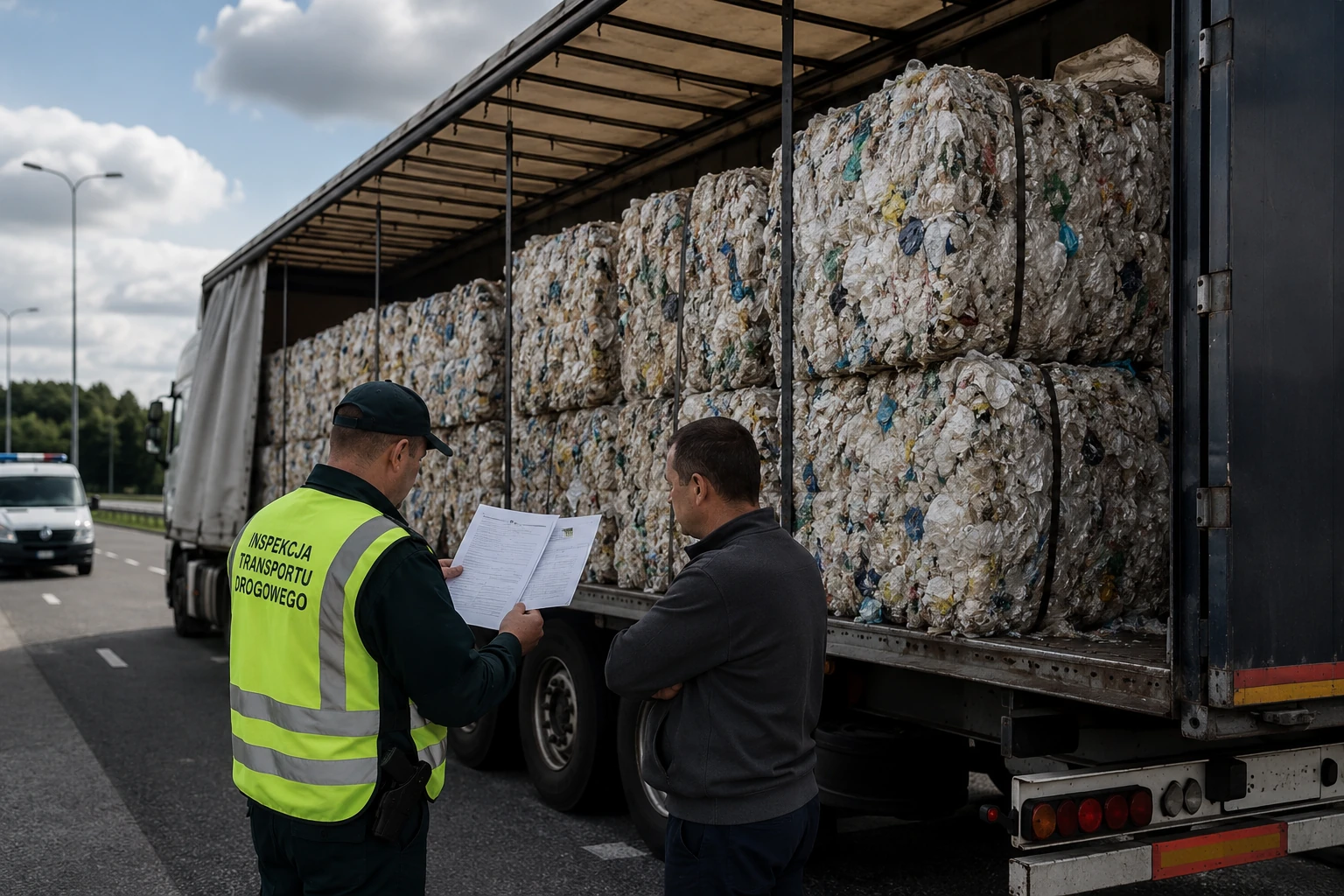
During a roadside inspection, authorities check not only the cargo itself but also the compliance of documents with the actual transport process.
If it turns out that the waste originates from several consignors, and the carrier holds only one Annex VII, inspectors may question the documentation. A similar risk arises when one document covers waste intended for several recipients.
Consequently, the carrier may face additional explanations, vehicle impoundment or other actions taken by the competent authorities.
The exception to this is where waste has been previously legally consolidated at an authorised facility with the appropriate administrative decisions. In such cases, further transport will be carried out from one location and under the control of one entity.
Practical note
Suppose a carrier collects 10 tonnes of PE film from a first consignor, and then loads an additional 10 tonnes from a second consignor. If the waste is loaded loosely or in a way that makes it impossible to distinguish clearly, a problem may arise during inspection in assigning individual batches of waste to the appropriate Annex VII. In such a situation, the control authority may consider that the documentation does not correspond to the actual load on the vehicle.
An even greater risk arises when waste is destined for several different recipients. In such cases, the carrier should be able to clearly demonstrate which part of the load is intended for a specific facility.
What are these limitations due to?
The new regulations have one main objective – to ensure the full traceability of waste at every stage of transport.
This allows the authorities to quickly establish:
The simpler and more transparent this chain is, the easier it is to verify the legality of the transport.
That's why Water it is based on a simple principle:
one sender → one recipient → one Annex VII.
This does not mean, however, that one load cannot carry waste from several consignors or for several recipients. Instead, it means that each relationship between a consignor and recipient requires separate documentation and must allow for the unambiguous identification of the waste during inspections.
Therefore, before planning a top-up or partial unloading, it is worth checking whether the transport arrangement will allow for full compliance between the actual course of carriage and the transport documentation.